Battleplan Strategy Guide: How to Conquer the Battle of Cherbourg
Master the Battle of Cherbourg in Battleplan with this tactical guide. Learn to manage supply lines, officer traits, and high-level strategy in this unique WWII sim.
Published: Battleplan Wiki Editorial Team
Table of Contents
Mastering the Battle of Cherbourg
The Battle of Cherbourg serves as one of the most critical early operations in Battleplan. As the largest deep-water port in the region, capturing it is essential for the Allied invasion to maintain momentum. Without this port, your forces in France will struggle to receive the necessary reinforcements and supplies from the Americas, potentially causing the entire invasion effort to fizzle out.
In this mission, you are not micro-managing individual infantrymen. Instead, you are sitting in the "General’s Chair," orchestrating the movement of entire divisions. The German defenders are heavily fortified along the perimeter north of Utah Beach. Your strategy should focus on "defeating in detail"—meaning you must isolate and destroy enemy units piecemeal rather than throwing your entire force into a meat grinder against a solidified front.
Tactical Approach for Cherbourg
Fix the Enemy: Use your infantry divisions (like the 50th Infantry) to pin the German defenders in place across the front line. This prevents them from reacting to your flanking maneuvers.
Execute the Breakthrough: Once the enemy is fixed, utilize your armored divisions (such as the 4th Canadian Armoured) to launch a breakthrough attack along the coast.
Secure the Flank: Drive toward the eastern flank of Cherbourg. Once you reach your objective, dig in immediately to maintain the corridor for incoming reinforcements.
Encircle and Siege: With the corridor secured, bring up your reserve divisions (like the Guards Armoured) to encircle the remaining German forces. Starve them out by cutting their supply lines.
Core Mechanics: The General’s Perspective
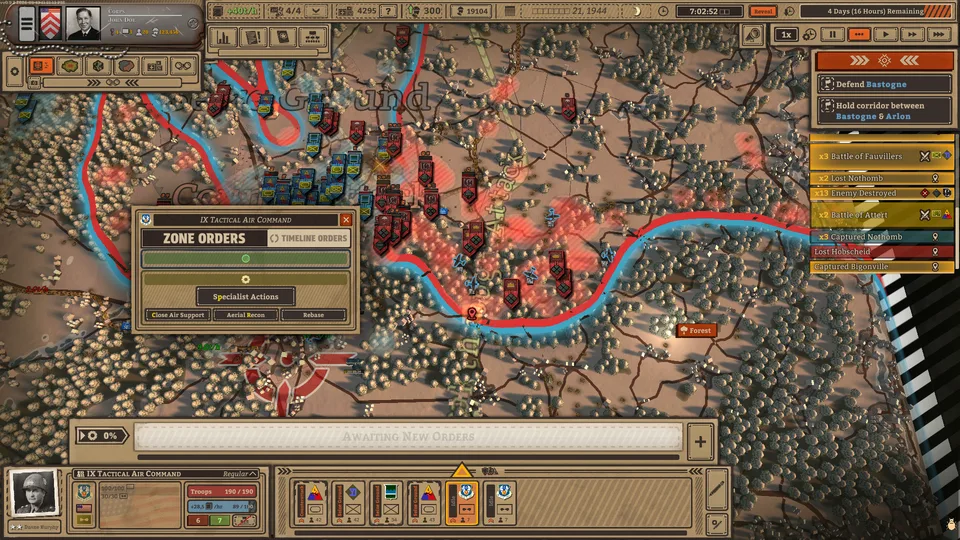
Battleplan distinguishes itself from traditional real-time strategy (RTS) games by distancing you from the tactical micro-management of individual units. Instead, the game emphasizes the administrative and strategic burden of command. You are responsible for the "big picture"—organizing the chain of command, defining objectives, and managing logistics.
The game utilizes a planning phase that feels akin to a general pouring over maps in a command tent. While you can issue orders, you must be mindful of the "Emergency Planning Session" system. You typically receive a limited number of these sessions per in-game day. If a plan goes sideways, you often have to wait until the next morning (05:00) to rectify the situation. This creates a high-stakes environment where your initial decisions carry significant weight.
Tip
Embrace the Planning Phase: Do not rush your initial orders. Use the planning phase to draw your lines of advance and defense carefully. Once the battle begins, your units will execute these plans autonomously, meaning your success is largely determined by the quality of your pre-battle preparation.
Army Organization and Officer Traits
A successful operation starts in the army builder. You aren't just selecting units; you are building a chain of command. Each officer you recruit brings specific traits that will fundamentally change how your divisions perform on the field.
When building your force, pay close attention to the personality of your commanders. An aggressive commander might boost damage output but leave your units vulnerable by lowering defensive stats. Conversely, a cautious commander might increase defense and survivability but at the cost of movement speed.
Recommended Officer Archetypes
The Aggressive Commander
Best for armored divisions tasked with breakthrough attacks. They provide the necessary punch to pierce enemy lines but require infantry support to hold the ground they gain.
The Cautious Strategist
Ideal for infantry divisions holding the line or securing captured territory. They excel in defensive scenarios where maintaining the perimeter is more important than rapid movement.
The Veteran/Reliable Leader
These officers are crucial for your core formations. They often provide bonuses to morale and veterancy gain, which are vital for long-term operations where your troops will be under constant stress.
Logistics: The Lifeblood of Your Advance
In Battleplan, supply is not an abstract concept; it is a physical mechanic that dictates the pace of your campaign. If your units run out of supplies, their combat effectiveness plummets, and they become easy targets for German counterattacks.
Supply depots are the anchors of your operational map. You need to capture and maintain these depots to fuel your advance. As you push forward, you must ensure your supply lines remain intact. If the enemy cuts off your supply route, your forward units will be stranded, forcing you to initiate a retreat or a desperate relief operation.
Logistics Checklist
[ ] Identify Supply Depots: Always know the location of the nearest supply depot on the map.
[ ] Monitor Supply Flow: Use the terrain view to see how supplies are reaching your front lines.
[ ] Strategic Retreats: If your units are low on supplies and in danger of being cut off, do not hesitate to pull them back to a secure supply zone.
[ ] Capture Enemy Depots: Prioritize seizing enemy supply depots to both bolster your own logistics and starve the opposition.
Lessons from the Field: Tips and Common Pitfalls
Based on community reports and gameplay experiences, the most common error new commanders make is "over-extending." It is tempting to push your armored divisions as far as possible to capture objectives quickly. However, without infantry to secure the flanks and supply lines to keep the tanks fueled, these units will inevitably be surrounded and destroyed.
Another pitfall is ignoring the "resting and refitting" phase. After a major engagement, your units will be disorganized and under-strength. Forcing them into another battle immediately is a recipe for disaster. Allow your divisions time to recover, and use this downtime to rotate fresh units to the front.
Warning
Avoid "Blitz" Mentality: While speed is important, Battleplan rewards patience. If you rush blindly into enemy territory without proper planning or logistical support, you will likely find your units cut off and destroyed. Always ensure your advance is supported by artillery and sufficient logistics.
FAQ
Is Battleplan a traditional RTS game?
Not exactly. While it shares some visual similarities, it is a high-level strategy simulator. You set the plans, and your officers and companies carry them out autonomously. It sits somewhere between a turn-based strategy game and a real-time sim.
Why are my units struggling to advance?
Check your supply lines. If your units are not within range of a supply depot or if the route is blocked, they will lose combat effectiveness. Additionally, ensure you have set proper orders (like "Seize Ground" or "Breakthrough") rather than just leaving them on "Balance Hold."
How do I handle interface difficulties during large battles?
The map can become crowded. Use the unit list on the left side of the screen to select divisions; clicking them will snap the camera directly to their location. This is much more efficient than trying to find specific units by scrolling across the map.