Battleplan Review: Is This World War II RTS Worth Buying?
Discover our in-depth battleplan review, covering real-time strategy mechanics, command systems, community feedback, and whether you should buy it.
Published: Battleplan Wiki Editorial Team
Table of Contents
Introduction to Battleplan's Operational RTS Design
Real-time strategy games often trap players in a frantic loop of clicking individual units, managing micro-transactions of actions per minute, and fighting the interface instead of the enemy. Battleplan, developed by Foolish Mortals Games Inc. and published by Slitherine Ltd., takes a vastly different path. Released on October 12, 2026, on Steam, this title shifts your role from a tactical squad leader to a high-level general overseeing month-long World War II operations.
If you are wondering whether this innovative wargame deserves a spot in your library, this review breaks down how its command mechanics work, what community reports highlight as its greatest strengths, and where its frustrating rough edges might test your patience.
Preparing Your Force: Order of Battle and Chain of Command
Before a single shot is fired across the massive historical maps, success depends heavily on your preparation phase. Unlike traditional RTS titles where you spin up units on the fly, this game asks you to carefully build and customize your battle group before deployment.
Analyze the Mission Objectives: Review the geographic data, terrain constraints, and expected enemy positioning on the target map.
Customize Your Order of Battle: Structure your divisions into corps, battalions, and companies, attaching specialized elements like engineers, anti-tank guns, and reconnaissance assets.
Establish Chain of Command: Hire and assign officers to your divisions, keeping their veterancy and potential quirks in mind as they gain campaign experience.
Plan Logistics and Supply Routes: Ensure your forces have adequate fuel and ammunition paths secured to sustain extended offensives.
According to community feedback and player experiences, crafting your army feels deeply rewarding. Watching units gain experience and stick with you through a campaign creates a genuine sense of attachment. However, getting the composition wrong at this stage can spell absolute doom once the campaign kicks off.
Translating Strategy: Drawing Orders on the Map
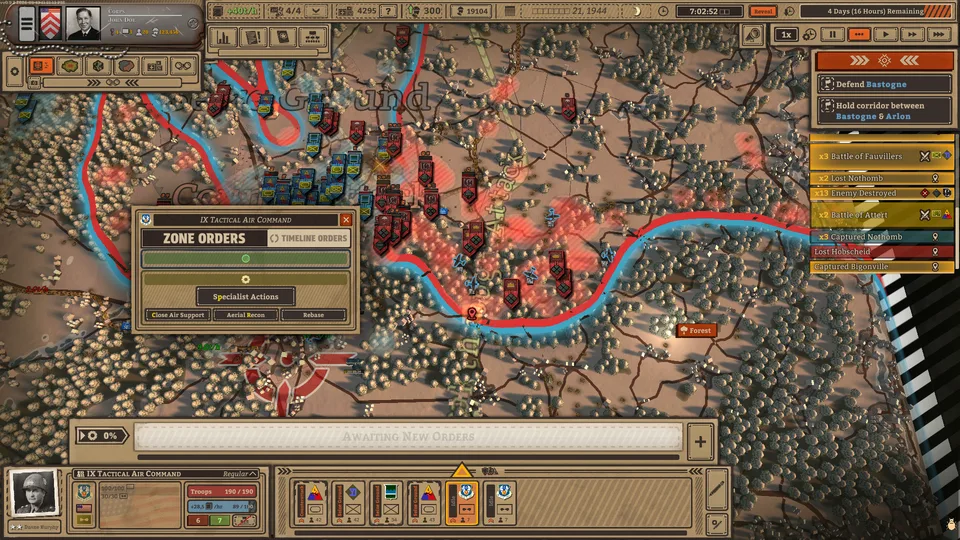
The centerpiece of the gameplay loop is direct map interaction. Instead of clicking units to move them tile by tile, you draw your operational intentions directly onto the battlefield interface.
Operational Drawing
Draw multi-stage offensives, flank routes, and defensive lines directly onto topographic maps derived from real-world geographic data.
Time Manipulation
Pause, play in real-time, or fast-forward through engagements that simulate combat second-by-second over weeks or months.
Combined Arms Coordination
Coordinate preparatory artillery barrages, infantry advances, and armored pincer movements to achieve deep encirclements.
When a plan works, it feels magnificent. Setting up an artillery barrage to soften a stronghold, pushing infantry through a weak point, and watching it develop into a clean encirclement scratches a very specific strategic itch. You truly feel like a commander orchestrating a massive historical theater.
The Friction of Command: Clarity and Chaos
Despite its brilliant conceptual framework, player reviews and community reports point out significant friction points that can derail the experience. War is chaotic, but game interfaces should help you navigate that chaos rather than add to it.
Warning
Information Overload: During hectic engagements, the sheer volume of notifications and overlapping arrows on the map can make it nearly impossible to read what your army is actually doing or why units appear to ignore orders.
Community feedback highlights that when orders get tangled, distinguishing between a poor tactical plan of your own making and a UI interpretation failure becomes a frustrating guessing game. Enemy AI often puts up a remarkably competent defense, making your own lines look sluggish by comparison. Additionally, supply mechanics can occasionally baffle players, with friendly units running dry despite seemingly secure supply arteries while enemy pockets hold out indefinitely.
Campaign Progression and Logistics
Sustaining an army across the Western Front from 1944 onward requires strict attention to logistics. Capturing supply depots and severing enemy supply lines are just as vital as winning firefights.
Logistics Management: Supply flow is dictated strictly by terrain and captured hubs, forcing you to pull back bruised units to rest and recuperate.
Air Support Integration: Successful campaigns grant access to crucial external assets, including reconnaissance flights, fighter-bombers, and heavy bombers.
Historical Grounding: Maps are built using real-world geographic data, meaning elevation maps directly dictate where your artillery holds the high ground.
Players navigating these long-form campaigns note that keeping officers alive to build veterancy adds incredible depth. When an experienced division finally achieves a breakthrough after weeks of simulated struggle, the payoff is immense.
Frequently Asked Questions
What is the price and launch status of Battleplan?
The game launched on Steam on October 12, 2026, with a base price of $29.99 USD.
Is Battleplan suitable for casual RTS players?
No. The game focuses heavily on high-level simulation, historical realism, and operational planning. Casual players looking for fast-paced micro-management may find the learning curve and information clarity challenging.
What are the system requirements?
At a minimum, it requires a 64-bit Windows 10/11 system, 4 GB of RAM, an Intel Celeron G4920 or AMD Athlon 200GE processor, and DirectX 11 compatible graphics with 8 GB of available storage space.