Battleplan vs. Hearts of Iron: Key Gameplay Differences Explained
Discover how Battleplan differs from Hearts of Iron 4. We break down the unique mechanics, tactical scope, and simulation elements of Foolish Mortals Games' WW2 title.
Published: Battleplan Wiki Editorial Team
Table of Contents
Battleplan vs. Hearts of Iron: Understanding the Genre Shift
When players first encounter Battleplan, developed by Foolish Mortals Games Inc. and published by Slitherine Ltd., the visual interface and unit management systems often draw immediate comparisons to Hearts of Iron 4 (HOI4). However, it is essential to clarify that Battleplan is not a grand strategy game. While it shares a similar aesthetic and utilizes familiar concepts like frontlines and divisions, the core gameplay loop is fundamentally distinct.
Battleplan functions as a real-time strategy (RTS) and simulation title. Where HOI4 tasks players with managing global politics, research trees, international trade, and national production over years of gameplay, Battleplan narrows the focus significantly. It acts more like a "football manager" for World War II battles. You are not managing a nation; you are managing a specific, high-stakes military operation on the Western Front.
The game, released on October 12, 2026, focuses on the "battle mechanics" that many strategy fans appreciate—simplifying the front line, creating divisions, and setting up attack moves—and elevates them into a standalone experience. If you are looking for a game that allows you to micromanage the global economy or conduct complex diplomatic negotiations, Battleplan will not provide that. However, if you are looking for a deep, simulation-heavy tactical experience that focuses on the "how" of winning a specific battle, this title offers a unique alternative.
Tactical Planning and Command Structure
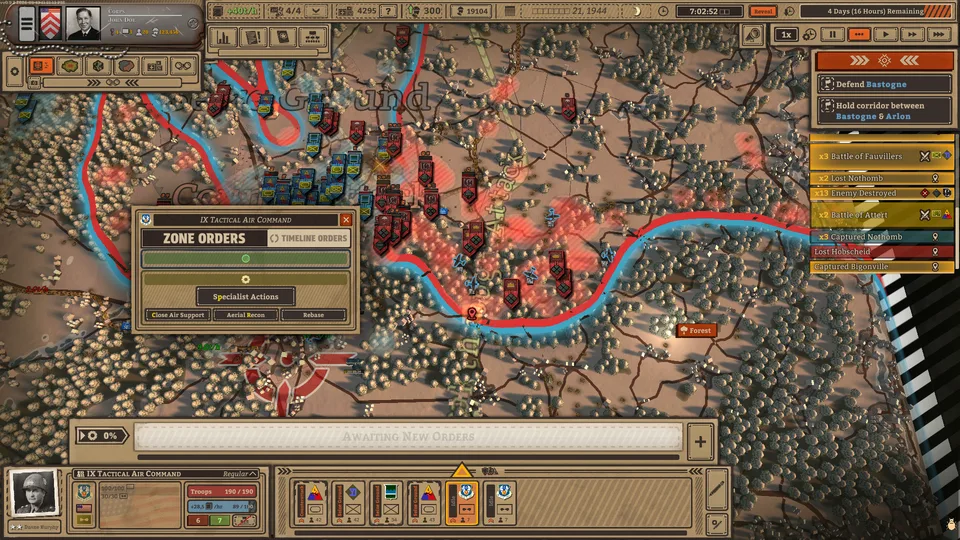
One of the most innovative features in Battleplan is the direct map-drawing interface. This mechanic serves as the primary way you interact with your units. Instead of clicking on individual units and moving them square by square, you draw your battle plans directly onto the map.
This approach creates a sense of high-level command. You are the general issuing orders, and your officers and companies are the ones carrying them out autonomously. This system allows for:
Multi-stage Offensives: You can plan complex maneuvers, such as defensive, offensive, and withdrawal actions, which your units will execute based on your instructions.
Sequential Orders: Orders can be cued up for each division, allowing you to orchestrate coordinated moves across multiple fronts.
Time-Sensitive Execution: You can set actions to be executed based on specific dates, times, or signals, which is vital for timing a coordinated strike.
Tip
Mastering the Planning Phase: The planning phase is where the game’s complexity truly shines. Do not be fooled by the simple look of the command screen. You can set up defensive-in-depth, counterattacks, and coordinated bombardments. Take the time to pause the simulation frequently to adjust these plans as the situation on the ground changes.
While the game emphasizes macro-strategy, it does not strip away your control entirely. If a specific regiment is in danger, you retain the ability to micromanage them to get them out of harm's way. This hybrid approach—macro planning with micro-intervention capabilities—is what distinguishes Battleplan from the passive, automated combat often seen in other strategy titles.
Simulation Depth: Logistics and Geography
The simulation in Battleplan is designed to be realistic, treating the movement of war with serious attention to detail. The developers have utilized real-world geographic data to create the battlefields, meaning rivers, hills, forests, and swamps are placed exactly where they were in historical reality.
This is not just for visual fidelity; the terrain has a direct, measurable impact on your operations. A division of armor, for example, will struggle to traverse rough terrain like swamps, and your supply lines will be hindered by the environment.
Logistics and Supply Chains
Logistics is a central pillar of the gameplay. To succeed, you must:
Cut Enemy Supply Lines: Starving the enemy is just as effective as direct combat.
Capture Supply Depots: Fuel your advance by securing these critical points.
Manage Retreats: Know when to pull back your units when they run low on supplies.
The simulation runs second-by-second, day-by-day. You can manipulate time—pausing, playing in real-time, or fast-forwarding—to manage the flow of the battle. This creates a rhythm where you plan, execute, observe, and react to the changing situation.
Things to Consider Before Attacking:
[ ] Elevation: Have you placed your artillery on high ground using elevation maps?
[ ] Visibility: Is it nighttime? Remember that visibility drops to near zero, allowing for masked maneuvers or surprise dawn attacks.
[ ] Supply Flow: Does the terrain allow for your supply chain to reach your forward units?
[ ] Unit Status: Are your divisions wounded? Sometimes, letting a unit rest and recuperate is the most strategic move.
Campaign Structure and Scope
Unlike the open-ended nature of grand strategy games, Battleplan is mission-based. The campaign focuses on the Western Front of World War II, starting from 1944. There are over 10 massive historical battles to play through.
Each mission has a specific time limit, ranging from a week to a month. This temporal constraint adds a layer of urgency to your planning. You cannot afford to spend months preparing for a single engagement; you must balance the need for a "perfect plan" with the reality that plans often fall apart in the heat of combat.
Players can choose to play as American, British, or Canadian forces, or mix and match them to create a custom force. Throughout the campaign, you can upgrade your divisions with new attachments, promote officers, and gain powerful air support assets like recon and heavy bombers. The inclusion of officer veterancy—where your leaders gain experience and quirks—adds a persistent element to your army that carries over through the missions.
Is Battleplan Right for You?
If you are a fan of strategy games but find the "global" aspect of Hearts of Iron 4 overwhelming or tedious, Battleplan might be exactly what you are looking for. It strips away the politics and logistics of running an entire nation and focuses entirely on the theater of war.
However, if you enjoy the geopolitical, economic, and technological research aspects of HOI4, you may find Battleplan too narrow in scope. It is a tactical simulation, not a grand strategy sandbox. The game is designed for players who want to "put their general's hat on" and focus on the mechanics of battle, terrain, and command.
Tip
Community Insight: According to early player reports and discussions, the game rewards patience and planning. Because the simulation is detailed, players who rush into engagements without considering supply lines or terrain often find their plans failing quickly. Treat the "planning phase" as the most important part of your gameplay.
Frequently Asked Questions
Is Battleplan a grand strategy game?
No. While it shares some visual similarities with titles like Hearts of Iron 4, Battleplan is a real-time strategy (RTS) and simulation game focused on tactical, mission-based battles on the Western Front. It does not feature global grand strategy mechanics like national politics or economic management.
What is the primary focus of the gameplay?
The primary focus is on high-level tactical command. You draw battle plans directly onto a map, manage logistics and supply lines, and oversee the autonomous actions of your divisions. The game emphasizes macro-strategic planning and reacting to the realistic simulation of terrain and time.
Does the game include historical content?
Yes. Battleplan features 10+ massive historical battles set on the Western Front of World War II, starting from 1944. It uses real-world geographic data to model the battlefields, and includes historical photos and videos to provide context.
Can I micromanage my units?
While the game is designed for high-level "football manager" style command where officers act autonomously, you can still intervene and micromanage specific units (such as a single regiment) if you need to pull them out of a dangerous situation.